
Consumer Confidence is more than just a survey: recent research in narrative economics suggests it is a critical determinant of the American economy. Here is why:
Consumers control the economy, accounting for roughly seventy percent of GDP; their spending is heavily influenced by narratives. The narrative of fear and distrust, when sustained, has historically driven reduced spending and contributed to financial collapses. The earliest recessions in American history were even called “panics” because shifts in consumer behavior had created the economic downturns. For example, the Panic of 1819 was triggered by falling cotton prices and an overextension of credit; it resulted in a sharp contraction in spending, bank runs, and a multiyear period of distrust in government institutions.
The Federal Reserve, established in 1913, was itself a response to consumer sentiment. The Federal Reserve was created in the wake of the Panic of 1907, when failed speculation in trusts and banks led to widespread bank runs and a major liquidity crisis; as a result, consumers curtailed spending until confidence was restored through the actions and assurances of President Theodore Roosevelt.
The last major example of narrative driven economics is the largest financial crisis in American history, the Great Depression. This event was triggered by the stock market crash of 1929 and resulted in widespread fear that caused bank failures and a massive decline in consumption. To restore negligible consumer confidence, President Franklin D. Roosevelt resorted to “fireside chats,” informal radio addresses in which he explained newly enacted policies and economic improvements to reassure the American public and encourage spending.
To emphasize the importance of consumer sentiment, the University of Michigan Surveys of Consumers began in 1946 to systematically measure households’ attitudes toward the economy. The index is normalized to 1966, a period known as the Golden Age of Capitalism, characterized by strong economic growth, low unemployment, and price stability. Values above 80 indicate that consumers consider the economy stable with good prospects; values above 90 signify strong optimism and confidence in long-term growth; values below 70 reflect distrust in the financial system and fears regarding future economic prospects.
Currently, sentiment is low, with a recent reading of 55.1. Despite this, spending has remained robust, and the economy has rebounded from its Q1 decline. It will remain crucial for institutions to remain stable and for speculation to be tempered, as excessive risk-taking in any sector could amplify volatility, trigger price shocks, and undermine ongoing growth.
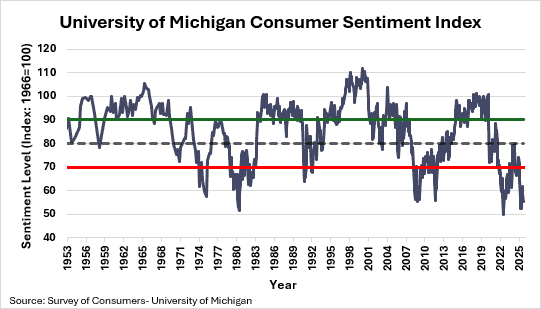
Currently, sentiment is low, with a recent reading of 55.1. Despite this, spending has remained robust, and the economy has rebounded from its Q1 decline. It will remain crucial for institutions to remain stable and for speculation to be tempered, as excessive risk-taking in any sector could amplify volatility, trigger price shocks, and undermine ongoing growth.
Disclosure
This material is provided by Gryphon Financial Partners, LLC (“Gryphon”) for informational purposes only. It is not intended to serve as a substitute for personalized investment advice or as a recommendation or solicitation of any particular security, strategy or investment product. Facts presented have been obtained from sources believed to be reliable. Gryphon, however, cannot guarantee the accuracy or completeness of such information. Gryphon does not provide tax, accounting or legal advice, and nothing contained in these materials should be taken as tax, accounting or legal advice. Individuals should seek such advice based on their own particular circumstances from a qualified tax, accounting or legal advisor.