
The Federal Reserve’s preferred inflation gauge delivered an expectedly high reading last week. The Personal Consumption Expenditures price index advanced 3.8% in April on an annualized basis, reaching its highest level since August 2023. The causes are not mysterious. The outbreak of the Iran war in late February 2026 disrupted oil and refined product exports from the Middle East, triggering a global surge in crude oil and retail gasoline prices. That kind of energy shock moves through an economy quickly and broadly, and the April PCE print is the clearest evidence yet that it has arrived in full force on American consumers.
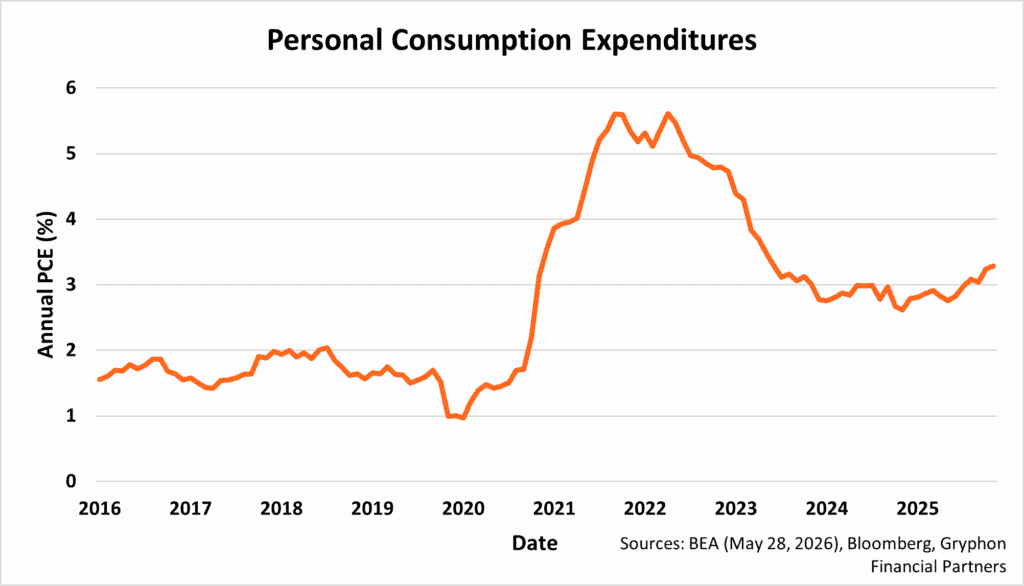
What makes this inflation episode particularly difficult is that it is not a single source problem. The rise in prices has been driven by higher energy costs linked to the war with Iran alongside the continued pass-through of tariffs into consumer prices. These two forces are compounding each other at the same time, leaving households with little relief from either direction. Unlike tariffs, which took months to filter meaningfully into prices, increases in oil prices are quickly reflected across budgets, raising the cost of gasoline, shipping, airline tickets, and products that rely on oil-based inputs. The speed of the energy channel is what makes the Iran conflict the more acute near term threat.
The consumer is feeling it. Real consumer spending, adjusted for inflation, increased just 0.1% in April after rising 1.6% in March, while personal income decreased 0.1% during the month. That is a sharp deceleration and it reflects households losing ground in real terms. The personal saving rate fell to 2.6% in April, down from 3.6% in March, meaning Americans are drawing down their financial cushions to sustain current spending levels. That is a dynamic that cannot continue indefinitely, and it is one of the more important stress points in the current economic picture.
The path forward hinges heavily on how the Iran conflict evolves. Even under a cautiously optimistic scenario in which the closure of the Strait of Hormuz lasts for just one quarter before oil exports gradually resume, the surge in oil prices is expected to raise U.S. headline inflation by 0.6 percentage points and core inflation by 0.2 percentage points in 2026. A prolonged conflict could push those numbers meaningfully higher. The OECD has warned that if the disruption drags on, U.S. inflation could reach 4.2% this year, while real GDP growth slows further to 1.7% in 2027. The range of outcomes is wide, and that uncertainty alone is a burden on business planning and consumer confidence.
The cautiously optimistic case rests on the fact that energy driven inflation, unlike wage driven or demand driven inflation, can reverse relatively quickly once the underlying supply shock resolves. Economists broadly forecast that oil prices will dip later this year, though they are likely to remain above pre-war levels throughout 2026. If a ceasefire or diplomatic resolution allows Strait of Hormuz traffic to normalize, the most acute price pressures could ease in the back half of the year, giving the Fed room to pivot and giving consumers a much needed reprieve. The economy is under real stress, but it is stress with a plausible exit, and that distinction matters.
Disclosure
This material is provided by Gryphon Financial Partners, LLC (“Gryphon”) for informational purposes only. It is not intended as a substitute for personalized investment advice or as a recommendation or solicitation of any particular security, strategy, or investment product. Facts presented have been obtained from sources believed to be reliable, though Gryphon cannot guarantee their accuracy or completeness. Gryphon does not provide tax, accounting, or legal advice. Individuals should seek such guidance from qualified professionals based on their specific circumstances.