
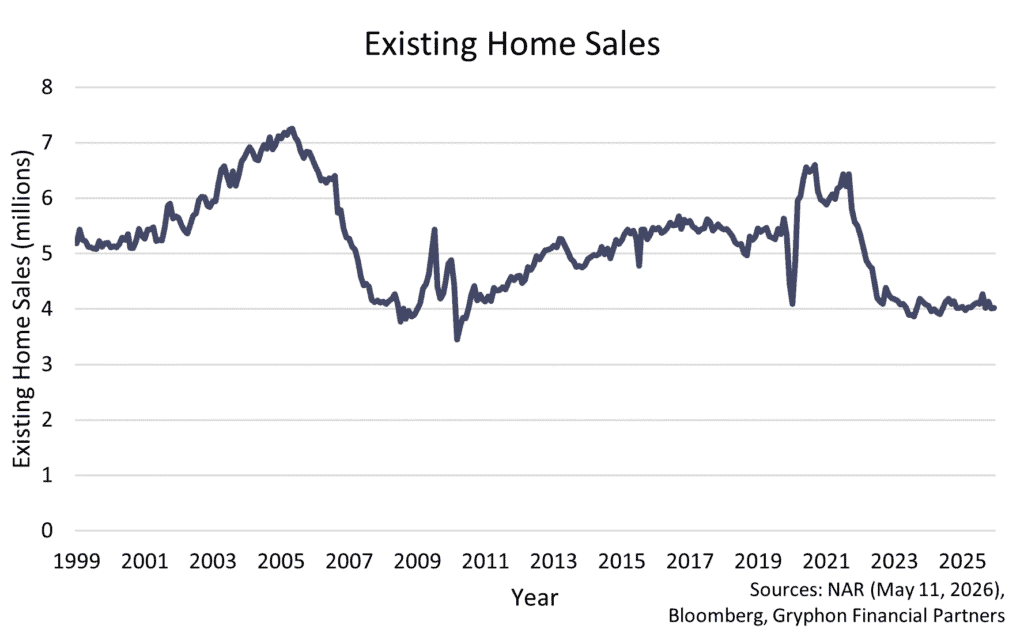
The latest existing home sales data paints a picture of a housing market that is steady but still working through several challenges. According to the National Association of Realtors, existing home sales in April 2026 rose just 0.2% from the prior month to a seasonally adjusted annual rate of 4.02 million units. While that number was weaker than economists expected, it also suggests that the market may be stabilizing after several years of elevated mortgage rates and affordability pressures. Existing home sales have now hovered near the 4 million level since 2023, below the long term historical average of roughly 5.2 million sales annually.
One encouraging development is that housing inventory continues to improve. Total inventory climbed to approximately 1.47 million homes in April, the highest level since 2019, while Realtor.com reported active listings rising 4.6% year over year nationwide. More sellers are beginning to enter the market, especially in the Northeast and Midwest where new listings increased sharply compared to last year. A healthier supply of homes is important because it gives buyers more choices and helps moderate price growth. After years of extremely tight inventory conditions, the gradual increase in available homes could help the housing market move toward a more balanced environment.
Home prices are still rising nationally, although at a slower pace than during the pandemic boom. The median existing home sales price reached $417,700 in April, up 0.9% from a year ago and marking the 34th consecutive month of annual price increases. At the same time, Realtor.com data showed median list prices declining 1.4% year over year, suggesting sellers are becoming more realistic about pricing as buyers remain sensitive to affordability. Mortgage rates near 6.3% to 6.4% continue to weigh on activity, but lower rates compared to last year and rising household incomes have improved affordability slightly. In April, the typical mortgage payment consumed 22.6% of a family’s income compared to 24.6% one year earlier.
For the broader US economy, the housing market remains an important signal. Existing home sales influence consumer spending on furniture, appliances, renovations, moving services, and financial services. Even modest stabilization in housing activity can support economic growth because housing tends to generate ripple effects across many industries. The fact that home sales are not collapsing despite higher borrowing costs reflects continued labor market strength and relatively healthy household finances. Buyers remain cautious, but employment growth and wage gains are helping maintain a floor under demand. Meanwhile, rising inventory may reduce some of the inflationary pressure that rapid home price appreciation created during the past several years.
Looking ahead, the most likely path for the housing market appears to be gradual improvement rather than a sharp boom or a severe downturn. Much will depend on mortgage rates, inflation trends, and consumer confidence over the next several quarters. Forecasts from Realtor.com and the National Association of Realtors anticipate modest gains in home sales during 2026 as inventory improves and affordability slowly recovers. That outlook suggests the housing market could become less of a drag on the economy and more of a stabilizing force. While challenges remain, especially for first time buyers, the latest data indicates that the market is adjusting to higher interest rates in an orderly way rather than experiencing major distress.
Sources: National Association of Realtors, Realtor.com Research, Associated Press, Wall Street Journal, Barron’s, Federal Reserve Economic Data (FRED), Axios.
Disclosure
This material is provided by Gryphon Financial Partners, LLC (“Gryphon”) for informational purposes only. It is not intended as a substitute for personalized investment advice or as a recommendation or solicitation of any particular security, strategy, or investment product. Facts presented have been obtained from sources believed to be reliable, though Gryphon cannot guarantee their accuracy or completeness. Gryphon does not provide tax, accounting, or legal advice. Individuals should seek such guidance from qualified professionals based on their specific circumstances.