
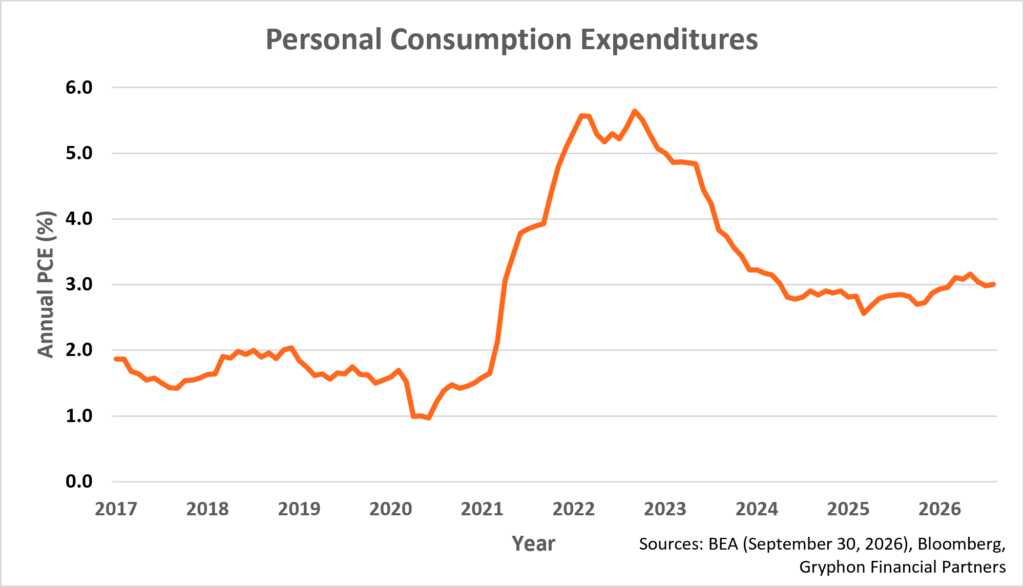
August’s Personal Consumption Expenditures (PCE) report, the Federal Reserve’s preferred inflation measure, showed inflation running cooler than expected even as consumers kept spending. Headline PCE rose 3.4% from a year ago, and core PCE, which excludes food and energy, rose 3.0%. Both came in below forecasts, helped by the Bureau of Economic Analysis’s annual update, which revised past inflation readings lower. On a monthly basis, core prices rose a modest 0.2%, suggesting underlying price pressures were relatively contained, even as energy costs remained elevated. At the same time, consumer spending jumped 0.9%, pointing to an economy that still has momentum. Even so, inflation remains well above the Fed’s 2% target, and the path back to 2% is likely to be gradual.
Inflation Comes in Cooler Than Expected
The PCE price index measures changes in the prices consumers pay for goods and services. It rose 0.3% in August, in line with expectations and up from a revised 0.1% in July. Over the past year, prices rose 3.4%, below the 3.7% economists had expected and unchanged from July’s revised annual rate. While one month of data does not establish a trend, the steady annual rate suggests overall price pressures did not accelerate further.
Core PCE excludes food and energy because those categories tend to experience larger short-term price swings. It rose 0.2% during the month, below the 0.3% economists expected and up from a revised 0.1% in July. On a year-over-year basis, core PCE rose 3.0%, compared with forecasts of 3.3% and unchanged from July’s revised reading. This measure is closely watched because it gives a clearer view of underlying inflation across the broader economy. A 0.2% monthly pace suggests underlying price pressures were relatively contained in August. At 3.0%, however, core inflation remains a full percentage point above the Fed’s target.
Why did the annual readings come in so far below expectations? This report included the Bureau of Economic Analysis’s annual update, which revised inflation data going back several years. It also changed how the agency measures a few categories, including computer software, portfolio management, and legal services. As a result, previously reported inflation was revised lower. July’s annual headline reading, originally reported at 3.7%, was revised to 3.4%, and core was revised from 3.3% to 3.0%. Economists’ forecasts were based on the original figures, so much of August’s apparent improvement reflects a lower starting point rather than a sudden slowdown in prices. Compared with the revised data, inflation held steady in August. The underlying trend is largely unchanged: inflation is moderating gradually, not falling quickly.
The details beneath the headline figures show where the pressure came from. Goods prices rose 0.3% after declining in July, driven largely by a 4.4% jump in gasoline prices as the conflict in the Middle East continued to keep energy costs elevated. Services prices also rose 0.3%, up from 0.1% in July, led by higher transportation services and restaurant and hotel prices. This distinction matters because energy can swing inflation quickly in either direction, while service prices tend to adjust more gradually and can be a more persistent source of inflation. Energy was the main driver in August, but firmer services prices suggest the path lower for core inflation may remain slow.
Consumers Keep Spending
The August report also showed a resilient consumer. Consumer spending rose 0.9% during the month, ahead of the 0.8% economists expected and up sharply from a revised 0.1% in July. After adjusting for inflation, spending rose 0.6%. Income growth, however, slowed. Personal income rose 0.2%, below the 0.4% expected and down from a revised 0.3% in July. Consumer spending drives a large share of U.S. economic activity, so this is a clear sign that demand remains healthy.
Strong spending, however, can also become a source of future inflation. When demand stays firm, businesses have more room to raise prices without losing customers. This is especially true in services such as travel, dining and transportation, where prices were already rising in August. This type of demand-driven inflation differs from the energy-driven increases seen this year. Energy prices can reverse quickly if supply conditions improve. Price increases supported by strong demand, however, tend to be more persistent because they reflect how much consumers are willing to pay. As a result, spending at this pace could make it harder for core inflation to keep falling, even if energy prices ease. There is also a limit to how long this can last. With spending growing well ahead of income, consumers are relying more on savings or credit to sustain it. If that support fades, spending may slow on its own, which would ease some of that pressure.
What It Means for the Fed and Investors
This combination of cooler inflation and strong spending is the key tension for the Fed. PCE is the measure the Federal Reserve uses to judge progress toward its 2% goal, and the Fed raised interest rates in September for the first time since 2023. A softer-than-expected reading offers some reassurance that price pressures are not building. However, core inflation remains well above target, and consumer demand this strong could keep upward pressure on prices in the months ahead. As a result, the report does not clearly resolve the Fed’s challenge of bringing inflation down while the economy continues to grow.
Overall, August’s PCE report points to an economy that still has momentum and an inflation rate that is moderating slowly. For investors, cooler inflation can ease some of the pressure on interest rates over time, while strong spending suggests growth remains on solid footing. The key questions going forward are whether energy prices stabilize, whether services inflation begins to ease, and whether consumer demand cools enough to allow inflation to move closer to the Fed’s target without a meaningful slowdown in the economy.
Disclosure
This material is provided by Gryphon Financial Partners, LLC (“Gryphon”) for informational purposes only. It is not intended as a substitute for personalized investment advice or as a recommendation or solicitation of any particular security, strategy, or investment product. Facts presented have been obtained from sources believed to be reliable, though Gryphon cannot guarantee their accuracy or completeness. Gryphon does not provide tax, accounting, or legal advice. Individuals should seek such guidance from qualified professionals based on their specific circumstances.