
U.S. productivity is usually shorthand for labor productivity: real output produced per hour worked, with the Bureau of Labor Statistics focusing on the nonfarm business sector because it captures most of the private economy. On the latest official data, nonfarm business labor productivity rose at a 1.8% annualized rate in Q4 2025, while unit labor costs climbed 4.4% and hourly compensation rose 6.3%; for full-year 2025, annual average productivity increased 2.2%. That is a solid reading by recent standards, especially because total factor productivity in the private nonfarm business sector also increased 0.8% in 2025, suggesting the gain was not just a quirk of hours worked but reflected broader efficiency improvements.
The bigger story is that productivity has improved from its weak pre-pandemic trend. BLS says the current business cycle has seen 2.2% annualized nonfarm business productivity growth so far, versus just 1.5% during the prior cycle from Q4 2007 to Q4 2019, and that 2.2% matches the long-run average since 1947. The recent annual numbers also show a rebound after the post-pandemic whiplash: productivity fell 1.5% in 2022, then rose 1.6% in 2023 and 2.3% in 2024, before reaching 2.2% in 2025. That matters because the U.S. is not just trying to grow output; it is trying to grow output without reigniting inflation, and stronger productivity is the cleanest way to support faster wage gains without automatically pushing businesses’ labor costs into prices.
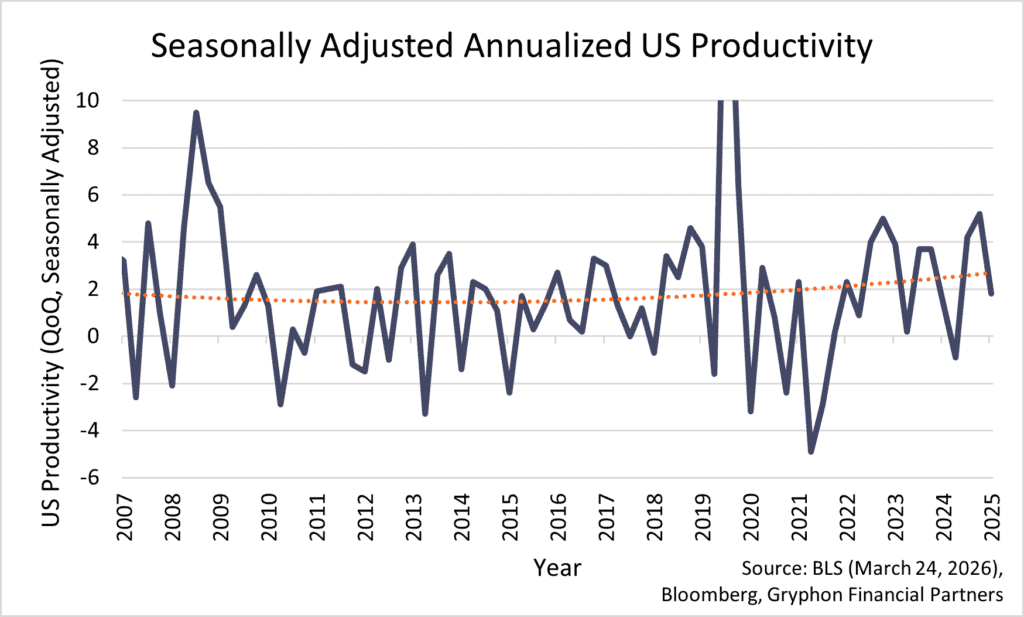
So what counts as “necessary” productivity growth? Given demographics, the answer is: probably at least around the recent 2% range, and ideally better. CBO projects real potential GDP growth of 2.1% per year from 2026 to 2030 and 1.8% from 2031 to 2036, while the overall labor-force participation rate drifts down from 62.5% in 2025 to 61.9% in 2036. CBO also projects potential labor force productivity to rise at an average annual rate of 1.5% from 2026 to 2036. In plain English, slower labor-force growth means the U.S. cannot rely on simply adding more workers the way it once did; if policymakers and businesses want stronger long-run GDP growth, better living standards, and healthier tax revenue, the heavy lifting has to come from productivity through business investment, technology adoption, skills, infrastructure, and efficient capital allocation.
The economic implications are enormous. When productivity rises faster than pay, unit labor costs cool; when pay rises much faster than productivity, cost pressure builds. Right now the mixed signal is that productivity has been respectable, but cost pressure has not disappeared: in Q4 2025, unit labor costs in nonfarm business were still up 4.4% annualized, while real GDP growth slowed to 0.7% annualized in the same quarter after 4.4% in Q3. That combination argues for cautious optimism rather than celebration: the U.S. has moved back toward a healthier productivity trend, but to keep inflation down while still delivering wage gains and faster trend growth, it needs productivity growth to stay persistently strong, not just pop for a quarter or two
Disclosure
This material is provided by Gryphon Financial Partners, LLC (“Gryphon”) for informational purposes only. It is not intended as a substitute for personalized investment advice or as a recommendation or solicitation of any particular security, strategy, or investment product. Facts presented have been obtained from sources believed to be reliable, though Gryphon cannot guarantee their accuracy or completeness. Gryphon does not provide tax, accounting, or legal advice. Individuals should seek such guidance from qualified professionals based on their specific circumstances.