
At different points in life, key moments create meaningful life transitions that often come with financial and personal decisions. Guided by our purpose of helping make people’s lives better, we continue our blog series focusing on these life transitions, offering perspective to help you navigate each one with clarity and intention.
The Financial Decisions That Matter Most at the Start of Your Career
Starting a career is often the first time financial decisions truly begin to take shape. With a steady income comes the ability to spend, save, and invest, often all at once. While many of these decisions may feel small early on, they have a lasting impact over time.
For someone in their early to mid-20s entering the workforce, the focus is often on managing day-to-day expenses and enjoying the benefits of a new paycheck. What is less obvious is that this stage presents one of the most valuable opportunities to begin building long-term financial momentum through both saving and investing.
Saving plays an important role early on. It provides stability and flexibility, allowing for emergency reserves and short-term needs. A strong savings foundation helps navigate unexpected events without disrupting long-term plans.
At the same time, investing is what drives long-term growth. While investments can fluctuate in value, they offer the potential for returns that outpace traditional savings over time. The key difference is not just risk, but time. The earlier someone begins investing, the more opportunity there is for growth to compound.
Compounding allows investment returns to generate additional returns over time. This creates a snowball effect where growth accelerates the longer money remains invested. Even a single investment can grow meaningfully given enough time.
The chart below illustrates this concept by comparing a one-time $10,000 investment, with no additional contributions, growing at an annual 10% return. It hypothetically highlights the difference in outcomes when starting at age 20, 30, or 40. With the same initial investment, starting earlier can lead to meaningfully different results over time, driven simply by the length of time the investment has to grow.
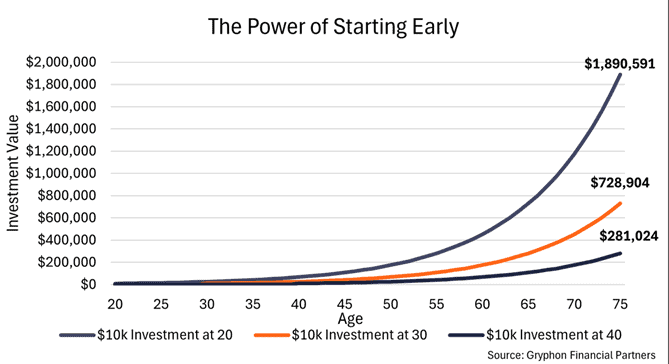
This is why the early years of a career matter. It is not about contributing large amounts or having everything figured out. It is about starting the process of saving and investing and allowing time to work in your favor.
Budgeting supports this process by creating awareness around income and spending. As income grows, maintaining structure helps prevent lifestyle creep and allows for increased saving and investing over time.
A few foundational steps can help guide early decisions:
• Build an emergency reserve for short term needs
• Take full advantage of any employer retirement match
• Consider account types early, such as a Roth 401(k) or Health Savings Accounts, which can provide long-term tax advantages
• Begin investing early and consistently, even if the starting point is small
• Set up automatic contributions so saving and investing happen consistently
• Increase contributions over time as income grows
• Take time to build your understanding of investing through trusted sources such as financial professionals, family members, and educational materials
• Understand how risk and return align with long-term goals
At the start of a career, financial decisions often feel small and easy to revisit later. In reality, they are what begin to shape everything that follows. Starting early is not about having everything figured out. It is about giving those decisions time to work, so they can build into something meaningful over time. Having the right guidance and structure in place can help those decisions become more intentional over time.
Disclosure
This material is provided by Gryphon Financial Partners, LLC (“Gryphon”) for informational purposes only. It is not intended as a substitute for personalized investment advice or as a recommendation or solicitation of any particular security, strategy, or investment product. Facts presented have been obtained from sources believed to be reliable, though Gryphon cannot guarantee their accuracy or completeness. Gryphon does not provide tax, accounting, or legal advice. Individuals should seek such guidance from qualified professionals based on their specific circumstances.